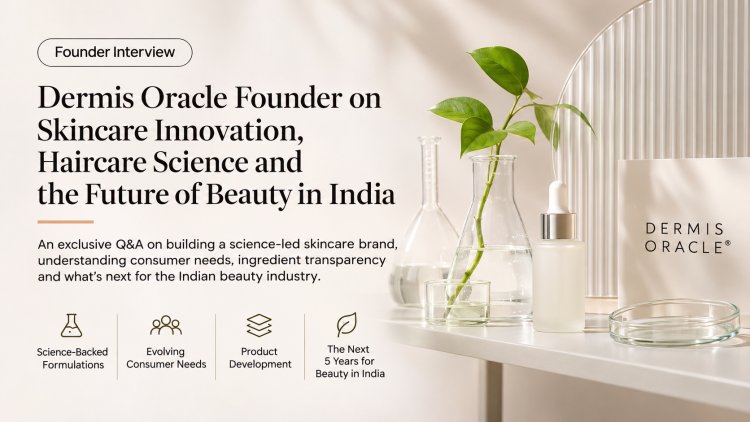
Dermis Oracle Founder on Skincare Innovation, Haircare Science and the Future of Beauty in India
In this exclusive interview, the founder of Dermis Oracle discusses the journey of entrepreneurship, the importance of science-backed skincare formulations, ingredient transparency, evolving consumer expectations, and the future of the Indian skincare and haircare industry.
Q1. You launched Yellowave Skin at the age of 21, marking the beginning of your entrepreneurial journey. In retrospect, how did your experience of understanding customers shape the development of Dermis Oracle?
Starting my business at the age of 21 taught me an important lesson: attracting customers and earning their long-term trust are two very different things. A product's long-term relevance depends on whether it addresses a genuine consumer need and delivers a meaningful experience, rather than simply following trends, attractive packaging, or persuasive marketing claims.
That experience also taught me not to let market trends dictate product development. Understanding the underlying problem must always come before creating a solution. This philosophy became the foundation of Dermis Oracle, where the focus is on developing purposeful skincare and haircare formulations with clearly defined objectives and meaningful benefits.
Q2. What gap did you identify in the Indian skincare and haircare industry that inspired you to establish Dermis Oracle?
One of the significant opportunities in India's skincare and haircare industry lies in bridging the gap between scientific research and practical, consumer-friendly products.
Today, consumers have access to more information about skincare ingredients than ever before. However, identifying the right product for a specific skin or scalp concern can still be challenging. Ingredient-focused marketing can sometimes create confusion, particularly when the actual role and purpose of an ingredient in the finished formulation are not clearly communicated.
I believe that understanding the concern is just as important as selecting the ingredients. Dermis Oracle was established with this philosophy: to help consumers approach their skincare and haircare concerns through a more informed, thoughtful, and purpose-driven approach.
Q3. Consumers today are increasingly knowledgeable about skincare ingredients and product formulations. How is this changing the way beauty brands should engage with their audiences?
Consumer awareness has significantly raised the expectations from beauty and skincare brands. People are no longer interested only in knowing which ingredients a product contains; they also want to understand why those ingredients are included, how they function, and what benefits the overall formulation is intended to deliver.
For brands, this means moving beyond ingredient-led marketing and communicating the science behind their formulations more responsibly.
There is an important distinction between research conducted on individual ingredients and scientific evidence supporting the performance of a finished product. Brands must communicate this distinction clearly, avoid unsupported claims, and establish realistic expectations.
I believe effective audience engagement today is about educating consumers rather than overwhelming them with technical information. Transparency and accessible scientific communication will play an increasingly important role in building long-term consumer trust.
Q4. If you could change one common misconception in the skincare industry, what would it be?
I would like to challenge the misconception that a more complicated skincare routine automatically produces better results.
Effective skincare is not necessarily about using more products or combining a greater number of active ingredients. It begins with correctly identifying the skin concern and choosing suitable products that address it.
Even carefully formulated products may not deliver the intended results if they are being used to address the wrong concern. Similarly, combining multiple products without understanding their compatibility can create unnecessary complications and potential irritation.
A simple, consistent, and thoughtfully selected skincare routine can often be more practical than an elaborate one. The focus should be on choosing the right formulations and using them consistently rather than constantly adding new products.
Q5. Trends such as glass skin, elaborate skincare routines, and viral ingredients have gained popularity through social media. How can consumers distinguish reliable skincare information from misinformation?
Social media has made skincare information more accessible, but it has also made it easier for personal experiences and visual trends to be mistaken for universal scientific evidence.
For instance, the appearance of glass skin can be influenced by lighting, filters, makeup, individual skin characteristics, and other visual factors. What works for one person may not necessarily produce the same results for someone else.
Consumers should evaluate the credibility of information sources, be cautious of exaggerated promises, and distinguish between personal testimonials and scientifically supported claims.
Beauty brands and content creators also have a responsibility to communicate both the potential benefits and limitations of skincare products. The objective should be to educate consumers and encourage informed decisions rather than create unnecessary skin-related anxiety.
Q6. What goes into developing a skincare or haircare product that makes a complex dermatological concern easier for consumers to understand and address?
Product development should begin with identifying the specific concern and defining what the formulation is intended to achieve.
Instead of evaluating ingredients individually, it is important to consider the formulation as a complete system. This includes ingredient selection, appropriate concentrations, compatibility, formulation stability, usability, and overall product performance.
The research associated with an individual ingredient does not automatically establish the effectiveness of the finished product. This is why formulation-level evaluation, appropriate testing, and responsible claims assessment are essential parts of product development.
Equally important are the product's texture, application experience, and directions for use. A well-developed formulation should not only have a clearly defined purpose but should also fit naturally into a consumer's everyday skincare or haircare routine.
Q7. You have a background in visual storytelling and New Media Production. How has your experience in the creative arts influenced your approach to building a science-led skincare brand?
My experience in visual storytelling and New Media Production has significantly influenced how I approach communication, particularly when explaining complex concepts to a wider audience.
Skincare science can sometimes feel overwhelming because it involves technical terminology, ingredient interactions, and formulation-related concepts. Visual storytelling provides an effective way to organise information, simplify explanations, and make scientific concepts more accessible without compromising their accuracy.
I see creativity and scientific rigour as complementary but distinct elements. An engaging story should never exaggerate a product's capabilities or present a claim as scientifically established when the available evidence does not support it.
For me, creativity is about finding better ways to communicate science, helping consumers understand products, and making informed skincare decisions easier.
Q8. Beyond revenue, brand awareness, and product launches, how do you personally measure entrepreneurial success?
For me, success is not defined exclusively by financial performance. It is equally about the value a business creates, the principles it maintains, and its ability to grow without losing sight of its original purpose.
Entrepreneurship is a continuous learning process. It involves recognising mistakes, remaining open to new perspectives, and making decisions based on long-term objectives rather than getting distracted by short-term results.
I believe the quality of decisions made throughout the entrepreneurial journey is just as important as the outcomes themselves.
A business becomes truly successful when it continues to evolve, creates meaningful value for its customers, and remains committed to the purpose on which it was originally built.
Q9. As Dermis Oracle expands its digital commerce, product portfolio, and presence across India, what kind of beauty and dermocosmetic brand do you envision building?
My vision is to establish Dermis Oracle as a recognised dermocosmetic brand in India, with a specialised portfolio of skincare and scalp-care products.
I believe sustainable growth should be driven by a deeper understanding of consumer requirements rather than simply increasing distribution channels or continuously expanding the number of products.
Different skin types, scalp conditions, individual concerns, and climatic conditions can influence product requirements. Understanding these differences is essential when developing relevant and purposeful formulations.
Digital commerce also provides an opportunity to make product information more accessible. It can help consumers understand the purpose of a formulation, its suitability, and the correct way to incorporate it into their routines.
As Dermis Oracle grows, maintaining product quality, explaining formulation choices, and communicating responsibly will remain central to the brand's identity.
Q10. How do you see India's skincare and beauty industry evolving over the next five years, and what role will Dermis Oracle play in this transformation?
Over the next five years, I expect India's skincare and beauty industry to become increasingly focused on concern-specific products, greater scrutiny of product claims, and more informed consumers.
As ingredient awareness grows, consumers will increasingly want to understand how complete formulations work rather than making purchasing decisions based solely on individual ingredients or popular trends.
I also expect scalp care to receive greater attention as consumers become more aware of scalp health and the importance of distinguishing between cosmetic concerns and conditions that may require professional evaluation.
For Dermis Oracle, the opportunity lies in adapting to these changing expectations while maintaining a clear focus on research-informed product development, consumer education, and emerging skincare and haircare needs.
Ultimately, I believe the future of the Indian beauty industry will belong to brands that combine scientific understanding, purposeful innovation, transparency, and a genuine commitment to consumer needs.

What's Your Reaction?