From Digitization and Automation to RPA and AI: The Evolution of Intelligent Business Operations | Lokendra Tiwari, Bizfate Consulting
Digitization, automation, RPA, and AI are transforming intelligent business operations. This article by Lokendra Tiwari explores the evolution from basic process automation to RPA and AI-powered intelligent automation, highlighting operational efficiency, cost reduction, error minimization, workforce optimization, and how businesses can build a scalable, future-ready operating model.
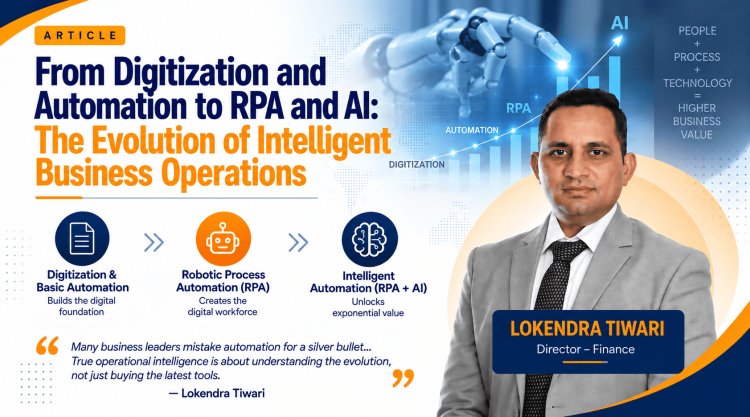
Many business leaders mistake automation for a silver bullet, only to see expensive tech investments stagnate in isolated pilot phases. True operational intelligence isn't about buying the latest tools; it is about understanding how digitization, conventional automation, RPA, and AI build upon one another. Organizations facing compressed transformation timelines, mastering this sequential evolution is no longer a luxury—it is the definitive line between bleeding capital and unlocking exponential business value. Research revealing that up to 45% of current business tasks can be fully automated using existing, deployed technologies.
The Automation Maturity Spectrum
To scale effectively, organizations must progress through three distinct technological milestones rather than treating them as interchangeable plug-ins.
|
Automation Stage |
Core Mechanism |
Chief Business Value & Industry ROI |
|
Digitization & Basic Automation |
Converts analog data to digital formats; enforces basic validation rules. |
Establishes a clean data foundation. Eliminates fragmented manual records. |
|
Robotic Process Automation (RPA) |
Employs software bots to mimic repetitive, rules-based human tasks. |
Slashes operational errors. Gartner notes first-year RPA adoptions yield anywhere from 30% to 200% ROI. |
|
Intelligent Automation (RPA + AI) |
Blends RPA execution with AI interpretation, pattern recognition, and decision support. |
Drives a 32% average cost reduction for mature organizations, according to global surveys by Deloitte. |
- Digitization + Automation: The Critical Foundation
- Data transformation:Converts paper records and manual ledgers into structured digital information.
- Process consistency:Replaces physical files with databases and manual registers with ERP transactions.
- Workflow modernization:Integrates system validations and automated alerts to reduce routine human intervention.
- Residual dependency:Leaves employees responsible for manual data entry and bridging unintegrated systems.
- Robotic Process Automation (RPA): The Digital Workforce
- Bot deployment:Deploys software bots to interact with legacy applications exactly like human operators.
- High-volume execution:Excels at high-speed processing of structured, low-ambiguity tasks.
- Audit compliance:Creates a flawless, 100% auditable digital trail for every processed transaction.
- Market adoption:the RPA market reached $3.8 billion in revenue in 2024, far outpacing broader infrastructure software growth as companies prioritize rapid, tactical efficiency.
- RPA + AI: Unleashing Intelligent Automation
- Cognitive interpretation:Extends capabilities beyond rigid rules to interpret unstructured layouts, emails, and contracts.
- Pattern recognition:Analyzes massive transaction volumes to flag anomalies and prevent operational risks.
- Synergistic execution:Combines AI's context-based decision engine with RPA's high-speed operational delivery.
- True autonomy:Drives end-to-end workflows where humans only intervene to handle highly complex exceptions.
The Strategic Dividend
- Operational savings:Lowers processing costs drastically while compressing turnaround times to minutes.
- Enhanced experiences:Minimizes human errors to uplift both vendor relationships and client satisfaction.
- Talent optimization:Frees finance and operations teams from repetitive data entry.
- Strategic reallocation:Reinvests professional hours into high-value forecasting, analysis, and strategic business partnership.
The Future: Human + AI + Automation
The target operating model does not replace human workforces with technology. Instead, it reallocates tasks based on relative strengths. Digital workers handle high-volume, rules-based burdens, while professionals contribute creativity, strategic judgment, and governance. In fact, intelligent automation significantly enhances workforce capacity while optimizing cost structures.
Stop Bleeding Capital on Isolated Pilots. Schedule Your Free Automation Roadmap Assessment Now.
Connect on LinkedIn to Claim Your Free Operational Strategy Session.
What's Your Reaction?