How Accel Skill Built a Zero-Fee Business Model in India's Overseas Placement Market
Discover how Accel Skill Edutech founders Yashwinder Paal Siingh and Archana Thakran are transforming overseas placement in India through a zero-fee recruitment model, AI-powered language training, verified global employers, and government partnerships.
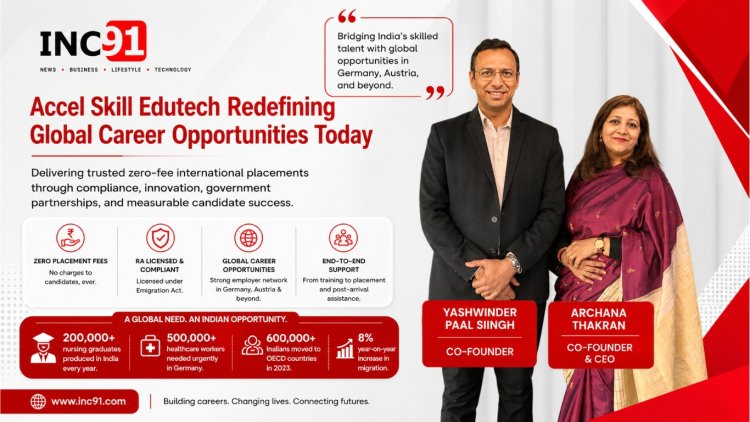
Most founders building in India's overseas placement sector reach for the obvious revenue lever: charge the candidate. Accel Skill Edutech Pvt. Ltd., a pre-seed startup incorporated in Noida in February 2024, deliberately built its business model around not doing that, and has turned the constraint into its sharpest competitive moat.
Sizing the Problem the Business Is Built to Solve
The scale of the underlying market opportunity is worth stating precisely before evaluating the business built around it. The OECD's International Migration Outlook 2025 places India as the single largest source of migrants to developed economies, with nearly 600,000 Indians moving to OECD countries in 2023 alone, an 8% increase year-on-year. Applications for the UK's Health and Care Worker visa from Indian nationals rose 75% over the same period. On the demand side, two-thirds of European companies report structural skill shortages, the EU's Digital Decade 2030 target requires 20 million additional ICT specialists, and Germany's healthcare system alone is short 500,000 workers. Governments on both sides have responded with policy: Germany's amended Skilled Immigration Act, a formal India-Germany Migration and Mobility Partnership Agreement, and an active India-Austria bilateral framework.
For a founder evaluating where to build, this is close to an ideal setup: large, growing, policy-supported demand meeting an equally large domestic talent supply, with the only missing variable being trustworthy infrastructure in between. That is the gap Accel Skill's business model is built to fill.
The Market Failure Behind the Opportunity
Co-founders Yashwinder Paal Siingh and Archana Thakran started from a diagnosis rather than a product idea. India produces around 200,000 nursing graduates a year; Germany alone cannot fill 500,000 healthcare vacancies domestically. Two-thirds of European companies report structural skill shortages, and the Gulf Cooperation Council faces comparable gaps in hospitality, construction and facility management. By any conventional market logic, India's labour supply and the developed world's labour demand should clear each other. They don't, because the intermediary layer, largely unregulated placement agents, has historically extracted fees from candidates while offering no accountability for outcomes, defrauding hundreds of thousands of workers annually in the process.
The founders' read: this isn't a supply-and-demand problem. It's a trust-deficit problem, and trust deficits are, for a founder willing to build the compliance infrastructure, a defensible business opportunity rather than a cost centre.
The Product Architecture, Step by Step
Understanding why Accel Skill's business model works requires walking through the actual candidate journey it monetises. It begins with a proprietary Language Learnability Assessment, a psychometric instrument that maps a candidate's cognitive learning profile, optimal learning modality, and predicted language-acquisition trajectory, producing a personalised roadmap rather than a generic course assignment. From there, training combines AI-powered adaptive modules with live virtual classrooms led by certified language trainers, taking Germany-bound candidates through a structured journey from German A1 to B2.
Beyond language training, the operational stack covers credential verification, employer matching through a curated network of verified German and Austrian employers, visa documentation support, and pre-departure cultural orientation. The differentiator, from a unit-economics standpoint, is what happens after the job offer: post-placement handholding through the candidate's first three to six months in-country, the period during which most competing agencies have already closed the file and moved on. Each of these stages is a cost centre the company absorbs upfront, deferring any revenue recognition until an employer or institutional partner completes their side of the transaction.
Building Compliance Into the Cap Table, Not Just the Brand
Accel Skill holds a Registered Recruiting Agent (RA) licence under India's Emigration Act, a status that subjects it to regulatory oversight and candidate-protection standards, and that, by law, prohibits charging candidates a placement fee. Revenue instead comes from the employer and institutional side of the marketplace. Yashwinder's own background, a defence-family upbringing spent moving across India, followed by extensive travel through developed economies observing how transparent labour markets function, shaped the conviction that compliance, done early, becomes a moat rather than a tax. Archana's parallel background in India's higher-education and skilling ecosystem supplies the demand-side credibility: relationships across colleges and institutions in healthcare, hotel management, engineering and vocational education that function as Accel Skill's candidate pipeline, reinforced by her own family's direct experience of Germany's Ausbildung programme.
Traction in Year One
For a pre-seed company, the institutional validation has moved fast. Within its first year of operations, Accel Skill secured incubation at Amity Technology Incubator under the Startup India initiative, signed MoUs with the Meghalaya State Skill Development Society and Medhavi Skills University, Sikkim, and closed its first seed tranche of capital. This pace of validation is notable in a sector where most early-stage operators struggle to secure even one government-facing partnership.
The product architecture reflects a founder team hedging against churn and refund risk in a sector notorious for both. A proprietary Language Learnability Assessment, a psychometric tool mapping cognitive learning profile and predicted acquisition trajectory, personalises each candidate's training roadmap rather than assigning a generic course. AI-adaptive modules combine with live-trainer classrooms to move candidates through language certification, German A1 through B2 for Germany-bound roles. The company maintains a curated network of verified German and Austrian employers for matching, alongside credential verification, visa documentation support and pre-departure orientation. Post-placement support continues for three to six months after a candidate lands, a retention and reputation mechanism as much as a service commitment, and the point at which most competing agencies have already exited the relationship.
The Three Moats: Compliance, Institutional Trust, Operational Depth
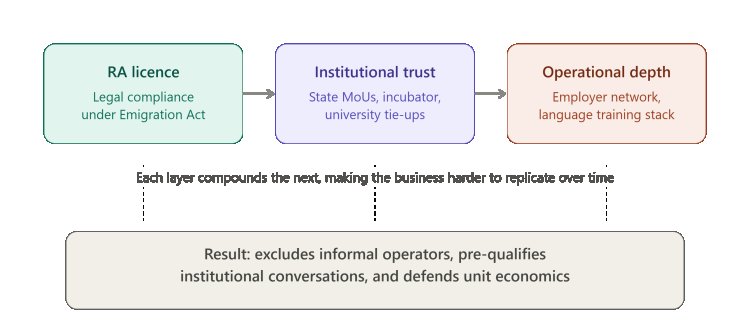
Accel Skill's defensibility rests on three layers that compound over time. The RA licence is the first: it excludes the majority of informal operators from partnering with the same tier of international employers, and it signals to those employers that Accel Skill operates within a legal framework they can safely engage with. Institutional trust is the second, and it compounds fastest: the Meghalaya State Skill Development Society MoU functions as a government's endorsement of the company as a trustworthy actor for its most vulnerable youth, a Centre of Excellence at RBMI Campus adds a credentialing layer, and Amity Technology Incubator's backing signals validation to investors and media alike, each partnership making the next easier to close.
Operational depth is the third moat, and arguably the hardest for a new entrant to replicate quickly. Building a functioning pipeline of verified European employers requires years of relationship capital and consistent delivery; building the language-training infrastructure to take candidates from zero German to B2 requires sustained curriculum investment. None of it is fast, and none of it is cheap, which is precisely why it defends the business once built.
The Product Is the Outcome, Not the Enrolment
Most skilling platforms in India are, in practice, course-delivery businesses that measure success in enrolments, certificates issued and Net Promoter Scores, with placement treated as an afterthought, a job board or a WhatsApp group of employers. Accel Skill's architecture inverts that: a candidate has received precisely zero value until they are in a verified job, performing well, and financially stable in their destination country. Everything before that moment is a cost the company absorbs, not a fee it collects. That framing shows up directly in the candidate stories moving through the pipeline today: Devyani from Churu, Rajasthan, working through German A2 with no prior exposure to a European employer before enrolling; Mukul from Delhi navigating the Ausbildung pathway; and Akshara from Kanpur, a nursing graduate now in advanced stages of her Germany placement with her German B1 certificate complete.
What the Unit Economics Signal
A business model that delays revenue until a candidate is verifiably employed abroad carries obvious cash-flow implications for a pre-seed company, training and placement costs are incurred well before institutional or employer-side revenue materialises. That the founders chose this structure anyway, rather than the faster-cash alternative of candidate-side fees, is itself a signal to prospective investors: it indicates a bet on long-term trust and repeat institutional relationships (state governments, universities, employer networks) over short-term transaction volume. In a sector where reputational damage from a single fraud scandal can permanently close off an entire pipeline of government partnerships, that trade-off looks increasingly rational rather than merely idealistic.
It also has a practical benefit for customer acquisition. Because the company cannot legally charge candidates, its outreach to colleges, state skill-development bodies and vocational institutions doesn't carry the credibility problem that fee-charging competitors face when pitching the same partners. The RA licence effectively pre-qualifies Accel Skill for conversations that would otherwise require months of relationship-building to earn.
The Fundraising Thesis
Accel Skill is in active conversations with impact investors and social venture funds with a mandate for SDG-aligned, outcomes-measurable investments in emerging-market talent mobility. The pitch maps cleanly onto four SDGs: quality education (SDG 4) through its AI-personalised learning platform; decent work (SDG 8) through verified, fee-free placement in above-market roles; reduced inequalities (SDG 10) through its tier-2/tier-3 and Northeast India focus; and gender equality (SDG 5), given the high proportion of women, particularly in nursing, among its candidates. For funds measuring both financial and development returns, that combination of a defensible compliance moat and a quantifiable social-impact thesis is an increasingly rare pairing at the pre-seed stage.
The Human Proof Points Behind the Metrics
For a pre-seed company, the strongest validation of a business model often isn't a term sheet, it's evidence that the product actually changes outcomes for early users. Accel Skill's earliest candidates offer exactly that kind of evidence. Devyani, from Churu, Rajasthan, had never spoken to a European employer and had no German language before enrolling; she is now working through German A2 with her credential verification in process, and describes the experience of believing her future is genuinely in her own hands for the first time. Mukul, from Delhi, is navigating the Ausbildung dual vocational pathway and describes Accel Skill as the first organisation that gave him an honest, step-by-step roadmap rather than a sales pitch, one that told him the difficult parts as well as the encouraging ones. Akshara, from Kanpur, a nursing graduate, is now in an advanced stage of her Germany placement application with her German B1 certificate complete.
These are not isolated success stories manufactured for a pitch deck; they are representative of a pipeline concentrated in tier-2 and tier-3 cities, skewed toward women, and drawn disproportionately from states with historically limited access to international career infrastructure, precisely the population segment that both impact investors and government partners are most interested in reaching at scale.
Where the Model Goes Next
The five-year roadmap calls for 15 state-level government MoUs by 2028, concentrated in Northeast India, Bihar, Rajasthan and Madhya Pradesh, ahead of a planned expansion into the UK, Japan, Canada and Gulf markets. Accel Skill's compliance-first architecture is explicitly designed to be portable across destination-country regulatory environments, a deliberate hedge against depending on any single corridor's policy stability. With Germany's Skilled Immigration Act amendments and the India-Germany Migration and Mobility Partnership both active, and India's own Emigration Act enforcement tightening, the founders are betting that the startups building compliant infrastructure now will be the ones still standing once the corridor matures, and the ones investors back first.
As Yashwinder puts it, the metric that matters isn't the placement rate or the revenue multiple, but the phone call a candidate makes home the day they land abroad. For a business model built entirely around delaying revenue until the outcome is real, that isn't just a founder sentiment, it's the P&L logic of the company.
Reading the Founding Team as a Portfolio Bet
For investors evaluating pre-seed teams in regulated, cross-border sectors, founder-market fit is frequently the deciding variable, and Accel Skill's team composition is built to answer that question directly. Yashwinder's defence-family upbringing across Indian cantonment postings, followed by extensive personal travel through developed economies, gives him a comparative, first-hand understanding of how transparent labour markets function abroad, the exact operational knowledge a compliance-first placement business requires. Archana's professional history inside India's higher-education and skilling ecosystem, combined with her own family's direct experience of Germany's Ausbildung programme, gives the company both the institutional access needed to build a candidate pipeline and a personal proof point that the destination-country pathway genuinely works.
That combination, one founder owning the regulatory and international-employer side, the other owning the domestic institutional and higher-education side, is precisely the kind of complementary founder structure early-stage investors in cross-border, regulated markets tend to look for, and it is reflected directly in the pace of the company's first-year institutional traction: an incubator placement, two government-facing MoUs, and a closed seed tranche, all before the business had completed its first full year of operations.
That last mile is the hardest mile. It is also the most important one.
|
About Accel Skill Edutech Pvt. Ltd. Accel Skill Edutech Pvt. Ltd. is a pre-seed international talent mobility platform founded in February 2024 and headquartered in Noida, Uttar Pradesh. The company operates an end-to-end international career pathway platform across three verticals — Nursing & Allied Health (Germany), Hospitality (Europe & Gulf), and Ausbildung (Germany) — covering AI-powered language training, employer matching, visa guidance, and post-placement support. The company holds a Registered Recruiting Agent licence under India’s Emigration Act, is incubated at Amity Technology Incubator (Startup India recognised), holds MoUs with the Meghalaya State Skill Development Society and Medhavi Skills University (Sikkim), and is a member of the Indo-German Chamber of Commerce. Zero placement fees — always. Founders: Yashwinder Paal Siingh , Co-Founder & Director · Archana Thakran, Co-Founder & CEO www.accelskill.com · RA Licence No. B-3416/UP/COM/100/5/11376/2026 · Noida, India |
Read more such stories on INC91.
What's Your Reaction?