Inside Avaan India: The Three-App Network Meera Singh Is Building to Make Shipping Self-Routing
Avaan India founder Meera Singh explains the Avaan Send, Avaan Hub and Avaan Partner network powering her bootstrapped shipping and logistics startup.
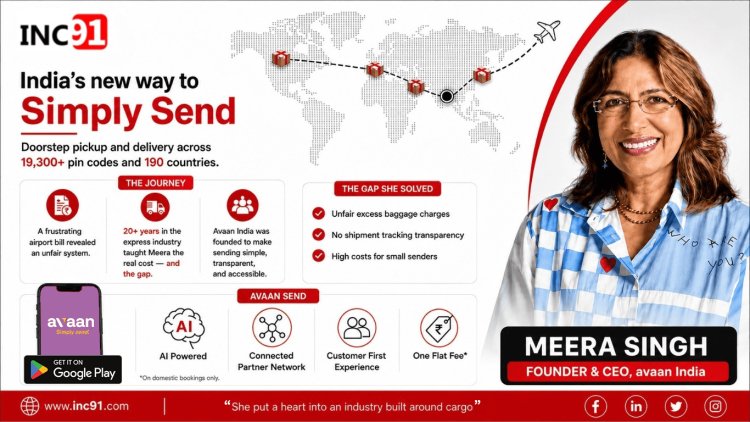
Most consumer logistics startups talk about the app the customer sees. Meera Singh, Founder & CEO of Avaan India, talks more readily about the two the customer never will. Behind the Avaan Send app that travellers and small businesses use to book a pickup sits a second system, Avaan Hub, running sort and warehouse operations, and a third, Avaan Partner, used by delivery executives on the ground. Together, Meera Singh says, they form a single network that already routes, sorts, and assigns a booking before a human has to step in — and that network, not any individual app, is the actual product Avaan India is building.
A Founder Who Thinks in Systems
Meera Singh's route into logistics technology did not start with a computer science background — it started with two decades inside the operational core of Gati, one of India's established express cargo brands, followed by a stint commissioning a 110 MW hydropower project in Sikkim, in the Northeast. She is, by her own account, the only woman entrepreneur to have successfully commissioned a private hydropower project of that scale in the region — a feat that depends less on visionary thinking than on getting complex, interdependent systems to work in the right order, every time.
That systems instinct is stamped across Avaan India's architecture. Where many logistics apps are essentially a booking form bolted onto a call centre, Meera Singh built Avaan India around integration from day one: a consumer booking on Avaan Send doesn't sit in a queue waiting for someone to assign it — it flows straight into Avaan Hub for sorting and into Avaan Partner for execution, automatically.
Why the Backend Mattered More Than the App
Avaan India's founding insight, as Meera Singh tells it, wasn't really about technology at all — it was about an airport bill. Two decades in express cargo had taught her almost exactly what it costs to move a kilogram of anything, anywhere in India. When she was charged a fee at an airport check-in counter that had little relationship to that real cost, and everything to do with her having no other option, she recognised a pattern: India's logistics industry had built extensive infrastructure for large businesses shipping in bulk, and almost nothing for the individual traveller or small seller.
That gap — the traveller with a couple of extra bags, the home baker, the small D2C seller, the boutique shipping ten to fifty parcels a week — is large, Meera Singh notes, and it had been consistently underserved: charged unpredictable rates, given no real shipment visibility, and treated as an afterthought by carriers built for volumes in the thousands. Closing it required more than a nicer-looking app. It required a backend capable of treating a single suitcase or a single parcel with the same rigor an enterprise shipment gets — without the enterprise price tag or the enterprise account manager.
How the Network Actually Works
Avaan India runs three consumer-facing services on top of its integrated backend:
- Excess Baggage, the company's founding product, offers doorstep pickup and delivery for travellers over their airline allowance, priced from under ₹89 per kilogram domestically — a fraction of standard airline counter rates.
- avaan Ship, the domestic parcel service, covers doorstep pickup and delivery across more than 19,300 pin codes in India, and is the service Meera Singh says small businesses rely on most.
- avaan Global extends the same doorstep-to-doorstep model to more than 190 countries for international shipments.
Each of these touches the same three-system network. Avaan Send captures the booking. Avaan Hub — Avaan India's sort and warehouse operations layer — determines routing and consolidation. Avaan Partner puts the job in front of the right delivery executive at the right time. Because the three talk to each other in real time, Meera Singh says a booking is "already routed, sorted, and assigned before a human has to step in" — a level of automation that most bootstrapped consumer logistics companies in India have not attempted, largely because it requires building infrastructure most founders would rather outsource.
Machine Learning as an Ongoing Investment, Not a Feature
Meera Singh describes Avaan India's use of machine learning not as a single feature but as a standing commitment: the company is using it to continuously improve how pickups are routed and how delivery windows are predicted, so that the network "keeps tightening itself rather than staying static." That framing — infrastructure that improves with every shipment rather than requiring periodic rebuilds — is central to how Meera Singh talks about where Avaan India is headed next.
Asked about the next five years, she is explicit that the roadmap is not about adding new verticals. It's about going deeper into the three services Avaan India already runs — Excess Baggage, avaan Ship, and avaan Global — until a traveller or small business never has to think twice about which one to use. The real product evolution, in her words, is "the network underneath all three getting smarter every day," not any single app on a customer's phone.
Built Without Outside Capital — On Purpose
It's worth noting what Avaan India's technology stack was built without: outside investment. Meera Singh has kept the company bootstrapped throughout, a decision she is unusually direct about, including its costs. Growing without external capital meant growing more slowly than Avaan India could have with it. It also meant every architectural and product decision — including the decision to build an integrated three-app network rather than a single customer-facing tool — stayed entirely hers to make.
That decision was tested early. When Meera Singh first floated a consumer-facing pricing model resembling Avaan India's inside a large cargo business years earlier, the pushback came from people who knew the industry well enough to be certain the economics of consumer volumes at consumer prices wouldn't work. She disagreed, and has continued to disagree — but the experience shaped her expectation that resistance to Avaan India's model would come from industry insiders rather than customers, and that building the technology to prove them wrong would be worth the extra time bootstrapping required.
Access was the next hurdle. Getting Avaan India's kiosks into secured airport environments meant navigating a long approvals process with little glamour attached. Trust followed close behind — Avaan India was asking customers to hand personal items to a brand with no track record in a category that had no real benchmarks. Meera Singh's answer was physical presence rather than advertising: putting Avaan India's kiosks and partnerships where customers already were, at airports and hotels, so the technology and the service could prove themselves directly rather than through a marketing claim.
The Kiosk as a Real-World Test of the Network
The clearest validation of Avaan India's network came, fittingly, at a kiosk rather than in a product review. Meera Singh describes the company's first airport kiosk pilot, in Delhi, as the moment Avaan India stopped being a proposition on paper. The kiosk put the company's booking, sorting, and delivery network in front of the exact customer, at the exact moment of need — and enough of them used it for Meera Singh to know the underlying system worked end to end, not just in a demo.
Avaan India's kiosks now operate across Delhi, Mumbai, Hyderabad, Jaipur, Navi Mumbai, and Goa, each one a live test of the same Avaan Send–Avaan Hub–Avaan Partner network, backed by 24/7 support and an avaan Coins loyalty layer.
Meera Singh's View on Building Technology Companies
Meera Singh's advice for founders is grounded in the same discipline that shaped Avaan India's architecture: solve a problem you have personally paid for, not one you've merely observed or researched. She's candid that her entire company grew out of one bill she was angry about — and that the specificity of that anger has been a more reliable design compass than any market study, particularly on the days building integrated infrastructure gets hard.
Her second piece of advice is aimed squarely at founders building against incumbents: expect the loudest objections to come from people who know your industry best. Experience is valuable, she says, but it tells you what has always been true rather than what could be. Listen carefully, then build your own answer.
Beyond the Network
Away from Avaan India's technology stack, Meera Singh is the author of An Ode to Sikkim and Mystique Shangrila, a TEDx speaker (TEDxParel, Mumbai), and runs Affordable Art with a Heart, a charity supporting differently abled child artists. She holds a postgraduate qualification in Management from the Oberoi Centre of Learning and Development, New Delhi, and trained earlier at the Institute of Hotel Management, Pusa. She was named among the Times of India's "Successful & Inspiring Business Leaders of 2023" and received the ET Inspiring Women Leaders Award the same year.
Avaan India, headquartered in Hyderabad, is available at avaanindia.com. Meera Singh can be followed on LinkedIn and Instagram.
To read more such stories visit INC91.
What's Your Reaction?